Backflow Prevention and Testing: Protecting Your Water Supply From Contamination
Imagine turning on your faucet at home to brush your teeth, and instead of clean tap water flowing out, you’re met with a discolored liquid that reeks of chlorine. Upon further investigation, you realize you left your garden hose submerged in your swimming pool, and due to a nearby water main break, dirty, chemical-laced water is now being drawn back into your home’s plumbing.
If you need clean water, whether you’re a home or business owner, taking the time to familiarize yourself with backflow prevention and testing can save you a headache, not to mention your health, a slew of hefty fines, penalties, and even service disconnection.
In this article, you will learn how backflow devices work, why testing is required, and how you can protect your water supply with proper backflow prevention and testing.
Table of Contents
- What Is Backflow?
- Who Needs Backflow Prevention and Testing Services?
- Backflow Prevention and Testing: Systems and Procedures
- Why Are Backflow Prevention and Testing Important?
- Frequently Asked Questions About Backflow Prevention and Testing
- All Pro Plumbing: For All Your Emergency Plumbing Needs
What Is Backflow?
Backflow is when water flows in the opposite direction into your water supply. When backflow occurs, contaminated water enters clean water lines back into the public water supply.
Backflow can be caused by a loss of pressure in the water supply, known as back-siphonage. This loss of pressure can occur if there is a break in the main water line or from sudden heavy water use, such as opening a fire hydrant.
Backflow can also develop as a result of backpressure. Backpressure happens when the pressure inside your plumbing exceeds the pressure of the water supply. This can occur if a device like a boiler or pressure washer generates greater pressure than the water supply.
If you suspect you may be experiencing backflow issues in your water line, it’s imperative to get a water line inspection immediately.

Who Needs Backflow Prevention and Testing Services?
Any business or commercial property must invest in backflow prevention and testing services. All businesses connected to the municipal water supply must have certified backflow prevention assemblies installed and tested yearly to ensure the water supply remains clean and uncontaminated, including:
- Medical offices
- Dental offices
- Mortuaries
- Restaurants and cafés (dishwashers, soda machines, etc.)
- Office buildings
- Shopping centers
- Laundromats
- Car washes
Additionally, many residential properties need backflow prevention and testing, especially if they have:
- Swimming pools or hot tubs connected to the water line
- Boilers or radiant heating systems
- Private wells tied into the public water system
- Underground irrigation or sprinkler systems, where fertilizers and pesticides can backflow
Many cities may even require annual testing for residential irrigation backflow preventers.
High-risk industrial facilities that use chemicals, solvents, or process water are required to have backflow prevention systems. Some are required to use the most protective type of backflow prevention assembly to avoid dangerous backflow accidents like the 2016 Corpus Christi, Texas, incident, which left over 300,000 residents without tap water for four days.
Industrial facilities that fall under the strict requirements typically include:
- Manufacturing plants
- Chemical processing facilities
- Power plants
- Laboratories
Public and institutional facilities often have systems with multiple backflow preventers protecting different water lines, like:
- Potable water
- Irrigation
- Sprinkler systems
Most municipalities or water districts mandate annual testing for certain types of connections, including those at public institutions like:
- Public swimming pools
- Schools and universities
- Hospitals
- Clinics
- Fire department
- Government or municipal buildings
Any property with equipment connected to a water line that could cause contamination must utilize backflow prevention and testing services.
Most city or water providers require annual testing and certification for certain types of connections. Failure to comply can result in notices of violation, fines, or service shut-offs.
Neglecting backflow prevention and testing will inevitably lead to a plumbing emergency in no time. Should calamity strike, call Portland’s trusted emergency plumbing experts at All Pro Plumbing. With over 20 years of expertise and experience, we’ve seen and fixed it all. Call us today for emergency plumbing services.
Backflow Prevention and Testing: Systems and Procedures
What Are the Types of Backflow Systems?
A backflow prevention system utilizes a series of valves to prevent water from flowing in the wrong direction and prevent contaminants from entering your local water supply.
There are four main types of backflow preventers for irrigation systems:
- Pressure Vacuum Breaker
- Reduced Pressure Zone
- Double Check Valve
- Atmospheric Vacuum Breaker (AVB)
While all four can protect the system as a whole, the AVB is most commonly installed after each zone’s control valve to keep individual zones safe.
Pressure Vacuum Breaker
The most common and affordable option, the Pressure Vacuum Breaker (PVB), prevents irrigation water from contaminating your home’s drinking supply. It’s usually installed above ground, near an exterior wall, or inside a recessed valve box.
The PVB assembly unit consists of two main parts: a check valve and an air inlet valve with a vent. When pressure drops, the air inlet opens to break the vacuum and stop contaminated water from flowing backward.
A PVB assembly is only recommended for irrigation without chemigation and only where there is a risk of back-siphonage. Backpressure cannot be prevented with a PVB backflow system.
Reduced Pressure Zone
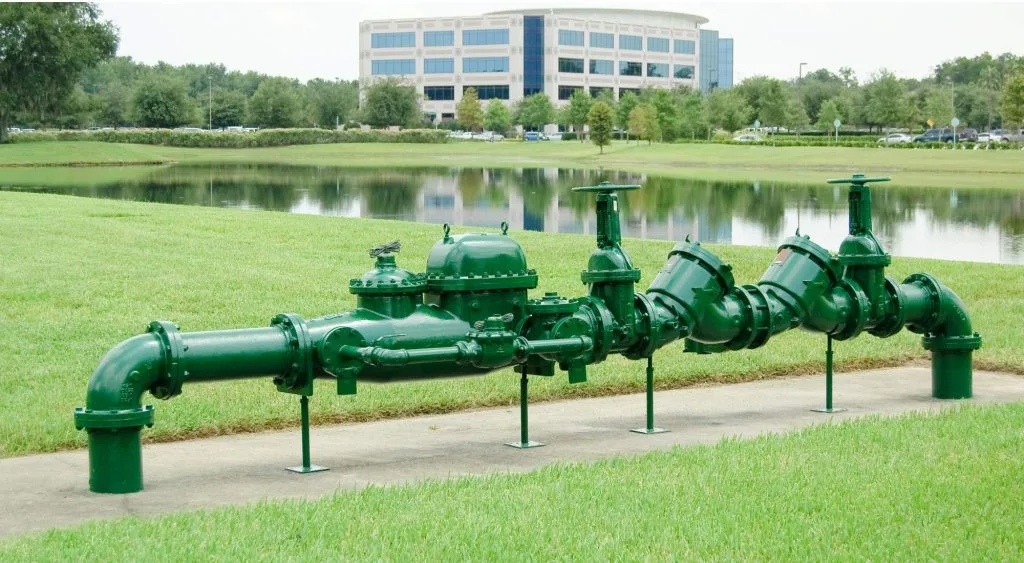
The Reduced Pressure Zone (RPZ) backflow system is designed for high-risk systems. It is the most advanced, reliable, and secure type of backflow prevention device available. Given the high cost and complexity, the RPZ system is designed to safeguard your drinking water and the municipal water supply.
An RPZ is installed directly in your plumbing system and typically includes:
- An inlet shutoff valve
- Two independently operating, spring-loaded check valves
- A relief valve
- Four test cocks
- An outlet shutoff valve
These components work together to provide maximum defense against contamination. This is the reason many building codes and local authorities across the country require RPZ backflow devices in many new constructions and commercial systems. To maintain their performance, annual backflow testing is essential to verify that each component operates at full capacity.
Double Check Valve
The Double Check Valve (DCV) assembly is ideal for below-ground or indoor installations, providing dependable backflow protection in moderate-risk applications. It’s also the most common inline backflow prevention device used in underground lawn sprinkler systems.
Installation requirements can vary by location. Some may mandate above-ground placement, while others allow horizontal or vertical configurations.
To ensure compliance and safety, always check with your local water authority and schedule annual backflow testing to confirm proper operation.
Atmospheric Vacuum Breaker
The Atmospheric Vacuum Breaker (AVB) is the simplest and least expensive type of backflow prevention device, commonly used for single- or dual-zone irrigation systems. However, it’s also the least reliable and least recommended option. Many urban and suburban municipalities do not allow AVBs for lawn sprinkler systems due to their limitations.
An AVB cannot be used:
- In systems under constant pressure
- Where shutoff valves are installed downstream
- In situations with possible backpressure
- With chemigation systems
Due to these limitations, an AVB is typically installed after each zone’s control valve to safeguard individual zones. Additionally, annual backflow testing is essential to confirm that every preventer is functioning properly and protecting your drinking water.
What Is Backflow Prevention Testing?
Backflow prevention testing is an annual inspection performed by a certified backflow tester and licensed plumber to ensure your backflow preventer is functioning properly. Backflow prevention testing typically consists of four procedures:
- Assessment
- Pressure testing
- Functional testing
- Report and recommendations
Assessment
Before your technician arrives, be sure you’ve prepared for your appointment to allow your plumber to deliver the best service possible.
During the assessment, your technician will temporarily shut off the downstream water valve before beginning any work. This allows the plumber to perform a visual evaluation of the backflow preventer and the surrounding area. The technician will inspect thoroughly, paying particular attention to any signs of wear, damage, or leaks.
Pressure Testing
The technician tests the pressure levels by attaching test kit hoses to the backflow preventer using small built-in nozzles called test cocks. This specialized equipment enables the plumber to measure the pressure at random points in the system. The varied points of measurement help confirm the pressure differential between the valves.
The pressure data is then analyzed to identify any inconsistencies that could indicate a failure or malfunction.
Functional Testing
The test kit applies pressure to the system to verify the efficiency of the check valve operation. The check valve’s primary function is to allow one-way flow and block reverse flow.
If you have a pressure reduction device with a relief valve, the technician will run tests to verify it functions properly under backflow conditions.
Report and Recommendations
Once the tests are complete, the technician will write a detailed inspection report. If everything is in good working condition and no problems are found, they’ll issue a certificate that must be submitted to the municipal water authority.
If the technician found any issues with the backflow preventer, they will provide recommendations for necessary repairs or replacements.
Why Are Backflow Prevention and Testing Important?
Backflow prevention and testing can predict and prevent several problems from occurring. Backflow prevention and regular testing of your backflow prevention system can help you:
- Prevent chemical contamination from hazardous waste such as herbicides and insecticides.
- Prevent exposure to heavy metals, most commonly in restaurants, where carbonated water can dissolve the copper in soda dispensers, potentially exposing customers to copper poisoning.
- Keep the community healthy by maintaining clean and safe drinking water.
Frequently Asked Questions About Backflow Prevention and Testing
How Often Is Backflow Testing Necessary?
It’s important to run backflow testing regularly. The exact testing recommendations may vary depending on the complexity of your backflow prevention system and the demand on your water supply. However, in most cases, scheduling your backflow testing annually is recommended.
Can I Do Backflow Testing Myself?
No, you cannot and should not test your backflow system yourself. Backflow testing must be done by a licensed plumber who is also an Oregon Health Authority (OHA)-certified Backflow Assembly Tester. Hiring a licensed professional who has expertise or certification in repairing backflows can save you from facing severe consequences in the future.
How Much Does Backflow Testing Cost?
Generally, the costs for backflow testing can range from $75 to $300 per device. Backflow testing costs can range depending on a variety of factors, including:
- The complexity of your device
- The service provider
- Failed previous tests that require repairs
To find the exact pricing, you will need to contact certified backflow testers in your area.
All Pro Plumbing: For All Your Emergency Plumbing Needs
Plumbing emergencies can catch you by surprise, especially if you haven’t been keeping up with your backflow prevention and testing.
All Pro Plumbing is Portland’s trusted go-to emergency plumber.
Problems with your main water line, like low pressure, leaks, and backflow, can cause extensive damage to your home or property and pose a serious risk to your health if your water supply is contaminated.
A local, family and veteran-owned business, the All Pro Plumbing team will help ensure that your water line emergency is resolved as quickly as possible. We’ll do everything possible to mitigate any damages. Afterward, we’ll provide recommendations for future maintenance and repairs that can be completed on a non-emergency basis to ensure your system is working perfectly.
If you’re experiencing backflow issues, contact All Pro Plumbing for emergency plumbing services today.